Sapphira
Acts of the ApostlesSapphira is the spouse of Ananias, and together they sell property, give only part of its price to the community, and misrepresent what they have contributed. In the account’s interpretation, their deception exposes a failure of trust in the community’s shared provision. Sapphira’s death, following her lie to Peter, makes the episode a grave warning about the ties between honesty, material sharing, and communal life.
Identity and Place in the Story
Sapphira appears in the account of Ananias and Sapphira in Acts 5:1–10, a story that contrasts their conduct with the faithful widow in Luke. The widow gives her last financial resource through the temple, trusting that provision for the poor will sustain her; Sapphira and Ananias instead retain part of the proceeds from a property sale while presenting their gift as if it were complete. The contrast turns on more than the amount surrendered: it distinguishes trust in shared provision from concealment and private retention.
The source describes Sapphira in relation to her spouse and their joint handling of the proceeds. It does not provide a separate biography or account of her life beyond this episode. Her role is nevertheless consequential: she is given an opportunity to answer Peter herself, and her own response repeats the deception.
The Property and the Deception
Ananias and Sapphira sell a piece of property and put some of the sale money into the community’s common treasury, keeping the remainder for private use. The account does not present keeping some proceeds as the offense in itself; its emphasis is that the couple acts as though they have committed the entire amount to the community. Their presentation therefore converts a decision about property into a lie about the terms of their contribution.
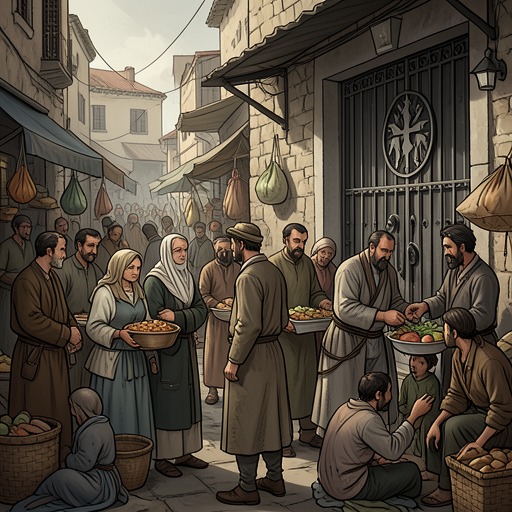
This act is set against the early community’s practice of holding resources in common so that no one among them is needy. The story links material sharing to the community’s stated purpose: members’ resources are meant to support one another, rather than to secure private advantage under the appearance of full participation. The earlier example of the widow sharpens the contrast. She entrusts her last resources to a system understood as a means of care for the poor; the couple withholds part of its sale price while claiming the standing of complete givers.
The interpretation also places the couple’s conduct within a larger contrast between the values of the old age and the Realm of God. Their withholding and deceit are treated as signs that they remain shaped by the old age, where broken relationships and the failure to support one another undermine communal life. The episode thus makes the handling of money a test of whether the community’s shared ideals are being embodied in practice.
Peter’s Confrontation and Sapphira’s Death
Peter first confronts Ananias with a direct accusation, and Ananias immediately dies. Sapphira is then brought into the same sequence of judgment, but Peter gives her an opportunity to tell the truth. She does not know that Ananias has died; she also lies, and is immediately struck dead. The order matters: Sapphira is not merely named as part of her spouse’s act but appears separately in the confrontation and makes her own answer.
The interpretation describes the couple’s actions as cheating and lying to the community. It also raises a difficult theological question about the account’s portrayal of divine punishment: whether preachers and congregations believe that God directly puts people to death for lying, misuse of funds, and other violations of the common good. The text’s severe outcome is therefore not reduced to a simple lesson about a couple’s punishment; it confronts readers with the challenge of interpreting divine judgment alongside the story’s ethical warning.
Meaning and Consequences
The episode is read as a cautionary account of what dishonesty and the refusal to use material resources for common benefit can set in motion. Lying damages trust between people; failure to share damages the possibility of a genuine community. In this interpretation, Sapphira and Ananias cannot survive within the setting their own conduct helps create. Their deaths give the warning its starkest form: the use of possessions is a matter of life and death because the bonds of trust and mutual support are essential to communal survival.
The warning extends beyond individuals. Groups and nations that deceive and hoard resources can foster distrust and hostility, conditions that ultimately contribute to their collapse. Sapphira’s story therefore belongs not only to a dispute over one property sale but also to a wider account of how economic conduct shapes shared life. Its contrast between private withholding and mutual provision asks whether a community’s actual use of resources matches its claims about belonging and care.